
Tonight I have been reading Galileo’s Letter to the Grand Duchess Christina, and I finally encountered, in its original context, a quotation I have read for years:
“The intention of the Holy Spirit is to teach us how one goes to Heaven, not how the heaven goes.”
I had heard the line many times before, but reading it in context gave it a force I had never quite appreciated. It is one thing to encounter a famous quotation detached from its argument; it is another to come upon it after following Galileo through the theological and philosophical reasoning that brought him there.
And the argument is remarkable.
Throughout the letter, Galileo labors to show that properly demonstrated truths about the natural world cannot ultimately contradict Scripture, just as Scripture, properly interpreted, cannot contradict the natural world. The reason is surprisingly simple: truth cannot contradict truth.
What fascinated me most as I read was how contemporary the argument feels. Galileo is writing in a world very different from ours, and yet at times the letter feels as though it could have been written yesterday (The letter was written in 1615). Beneath the particular controversies of his age lies a much larger question: What do we do when our reading of Scripture appears to conflict with what we observe to be true about the world?
Galileo’s answer is not to place science over Scripture. Nor is it to place Scripture over reality, as though the two could genuinely be opposed. Rather, he asks us to examine our interpretations of both.
After all, we can get science wrong. Our observations may be incomplete. Our methods may be defective. Our conclusions may outrun our evidence. Galileo himself understood this. But we can also interpret Scripture badly. And when a demonstrable truth about creation appears to contradict our interpretation of Scripture, perhaps the contradiction does not lie between creation and Scripture at all. Perhaps it lies between reality and our interpretation of one or the other. Sometimes I overcook my meals in the microwave, and sometimes I overcook my interpretations of Scripture and Science. I sure you probably don’t have that problem.
Galileo recognizes, moreover, that Scripture frequently describes the natural world from the standpoint of ordinary human experience. We still speak this way ourselves. We talk about the sun “rising” and “setting,” even though we know perfectly well what is happening astronomically. Such language is not false simply because it is not a technical description of celestial mechanics. It describes reality as human beings experience it.
This brought Calvin to mind. Calvin famously speaks of God accommodating himself to human weakness. God, as it were, “lisping” to us as a nurse speaks to an infant. Divine revelation comes to creatures in language creatures can understand. Galileo is working with something very much like this principle. Scripture was not given as a scientific textbook, and therefore we should not demand that its descriptions of natural phenomena function as though they were technical scientific propositions.
The question is not whether science gets to sit in judgment over Scripture. Nor is it whether we have license to deny what can actually be demonstrated about creation. The question is whether truth can contradict truth.
If there is such a thing as absolute truth, and if the God who speaks in Scripture is also the God who created the universe, then ultimately the answer must be no.
Reality cannot contradict reality.
Of course, our accounts of reality can contradict one another. Our scientific theories can be wrong. Our exegesis can be wrong. Our philosophical assumptions can be wrong. Human beings are perfectly capable of misunderstanding both books, so to speak: the book of Scripture and the book of nature.
But the books themselves, insofar as they have the same Author, cannot finally be at war.
That is the bunker-buster in Galileo’s argument for me.
It means that when an apparent conflict arises, the Christian need not fear investigation. We should instead ask better questions. Have we demonstrated what we think we have demonstrated? Have we interpreted Scripture as carefully as we think we have interpreted it? Are we requiring the biblical text to answer a question it was never intending to answer? Or have we elevated a provisional scientific theory into an unquestionable description of reality?
Those questions require humility from both directions.
And perhaps that is one reason this centuries-old letter feels so unexpectedly modern. Galileo is not merely arguing about astronomy. He is wrestling with the relationship between revelation, observation, interpretation, and reality itself.
There is another fascinating thread running through the letter: Galileo’s conviction that the natural world is profoundly mathematical. That deserves an essay of its own. For tonight, however, I am still thinking about this simpler claim, that genuine knowledge of creation and genuine knowledge of Scripture cannot ultimately be enemies because truth cannot be divided against itself.
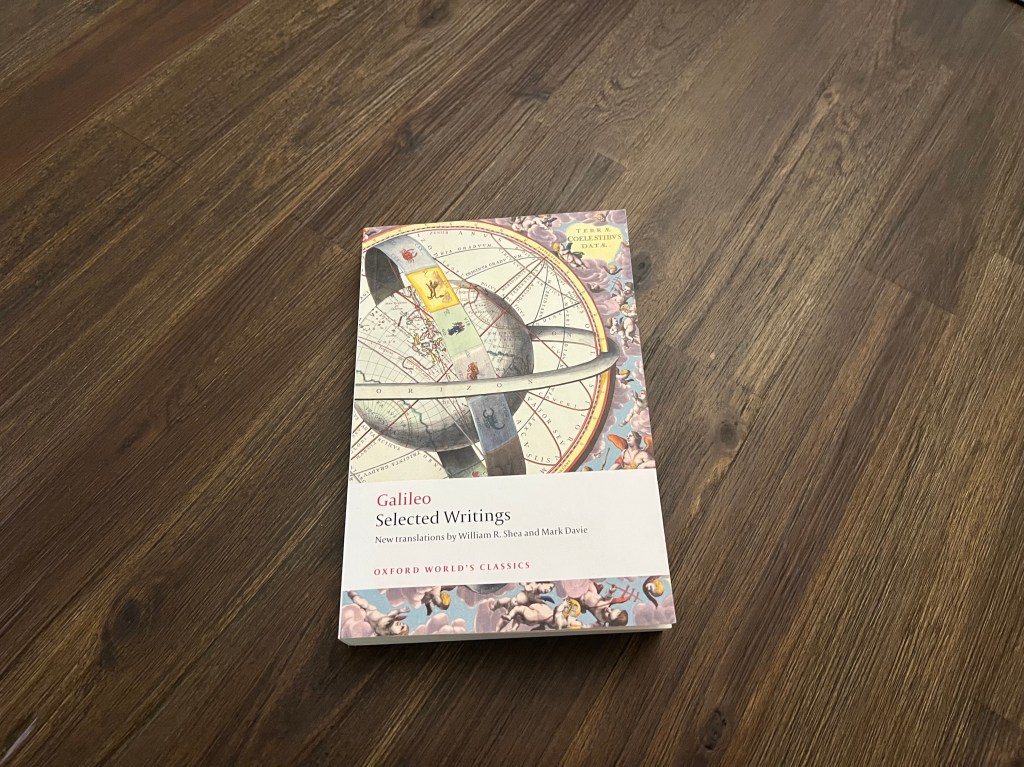
I intend to take another tour through the letter over the next few nights. The edition I am reading is the Oxford edition pictured with this post, and the passage that initially stopped me is on page 70.
And if you are particularly interested in Saint Augustine, Galileo’s use of him alone makes the letter worth reading. It is more than historically fascinating; at points I found it genuinely edifying. Augustine had thought deeply about questions concerning Scripture and the natural world long before anything resembling modern science existed, and seeing Galileo bring those insights into a seventeenth-century controversy is remarkable.
For now, though, I keep returning to that famous sentence, one I thought I already knew:
“The intention of the Holy Spirit is to teach us how one goes to Heaven, not how the heaven goes.”
It turns out that knowing the quotation and encountering the argument are two very different things.
Happy reading.


